


V Shape Module
The V-Shape is two modules in one, a wave twister and a distortion / wavefolding module. Both sections of the module are all analogue in design, and both can be used independently or they can be normalised together in series, so that a waveform can be twisted first and then distorted and wavefolded.
The wave twister can take (for example) a saw tooth waveform as an input and shape it, under manual or external voltage control, through to being a triangle waveform and on to being a ramp waveform, and produces a sound similar to pwm for sawtooths. It will also work with symetrical waveforms such as triangle and sine waves, again producing pwm like tones.
It can produce a wave twisting effect from most waveforms (with the exception of square waves), whether they are symmetrical or asymmetric. Under many conditions the transfer function is not perfect, so different harmonics may be generated too. The offset control allows a bias to be added to the incoming waveform, either to bias it correctly around zero or offset it for more distortion and harmonics.
The second part of the V-Shape module is a distortion unit, with selectable Soft or Hard Clipping, and the clipping amount can be varied either by a front panel control or an external control voltage with the "Distort" control. The distortion offset control adds or subtracts a bias voltage to the CV signal, to give an extended range of control. There is also a single stage, switchable wavefolder, which can be used with either soft or hard clipped waveforms.

Module Width: 10hp
Module Depth: 26mm (Including power lead)
Current Usage: 75mA Positive, 45mA Negative

In Depth
The V-Shape is two modules in one, a wave twister and a distortion / wavefolding module. Both sections of the module are all analogue in design, and both can be used independently or they can be normalised together in series, so that a waveform can be twisted first and then distorted and wavefolded.
The V Shape twister section functions according to the following mathematical formula:
Output = min(In/CV, (Inverted In)/1-CV),
where In is the input voltage and CV is the CV voltage.
The output waveform is around 10% to 90% duty cycle, as there is always a slight mixing of the inverse signal. It also relies upon the incoming waveform being exactly 10v peak to peak and biased equally around zero and if this is not the case then it will do some interesting non-linear distortions which, in conjunction with the Offset control, can generate a wider range of sounds.
The distortion section adds distortion without significantly varying the output level, particularly with the Hard clipping function, it maintains the same output level but gradually squares off the top of the waveform, great for creating waveforms suitable for woodwind type sounds, or just for adding a little voltage controlled "nastiness" to an incoming waveform. The wavefolder can be switched in separately and used with either the Soft, or Hard clipped waveforms.
The V Shape module has two separate paths that can be operated as individual functions, each with their own input/output sockets and CV control. The first path (INPUT to SP OUT) delivers Wave Twisting and the second path (DIST IN to DIST OUT) delivers Distortion with Wavefolding. However, if there is no connection to the SP OUT and DIST IN sockets, the INPUT is normalled to the DIST IN socket so that the signal takes a different route and will operate in series with the distortion path so that the audio signal will now be shape-twisted, distorted and wave-shaped with the output taken from the DIST OUT socket.
SHAPE
An audio signal applied to the INPUT socket can be shaped using the bipolar SHAPE control knob.
With the SHAPE control set fully anti-clockwise (position -5), the twisted signal will emerge from the SP
OUT socket inverted. This means that, for example, a positive-going (Ramping Up) Sawtooth Wave will
emerge as a negative-going (Ramping Down) Sawtooth Wave (Trace 1). With the SHAPE control set to
the centre (12 o'clock) position, a Triangle Wave will emerge
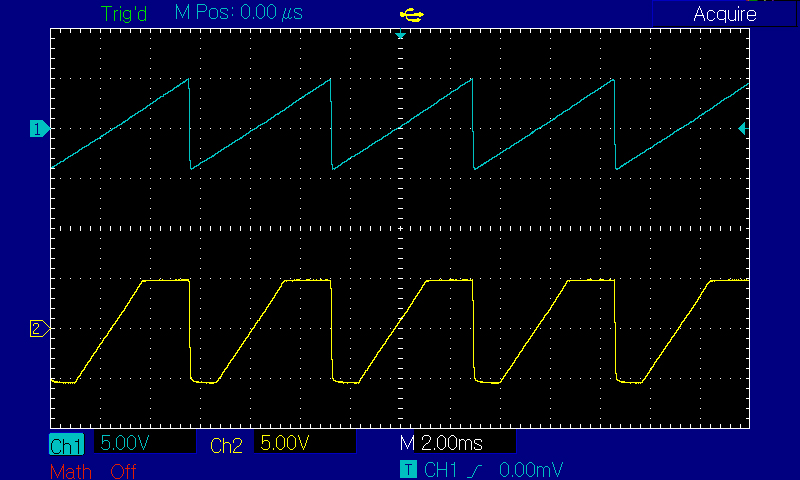
(Trace 2). With the SHAPE control set to
the fully clockwise (position 5), a positive-going (Ramping Up) cross between a Triangle Wave and a
Sawtooth Wave will emerge (Trace 3).
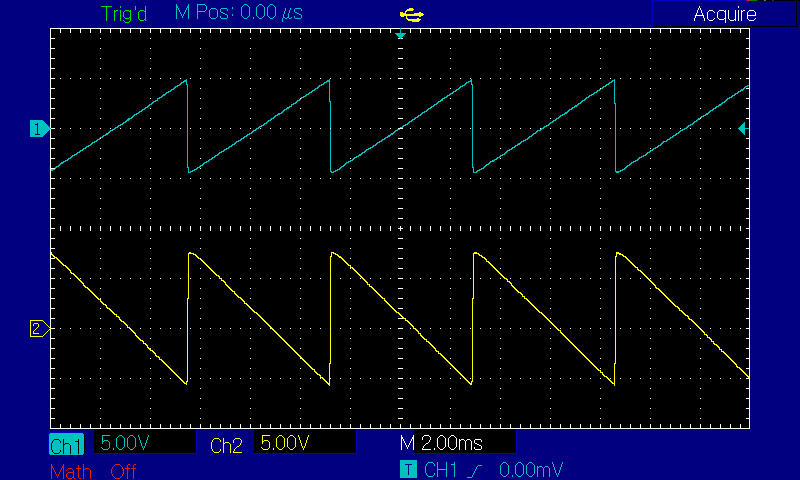
Trace 1. Blue trace is the original Sawtooth wave, yellow trace is the inverted wave.
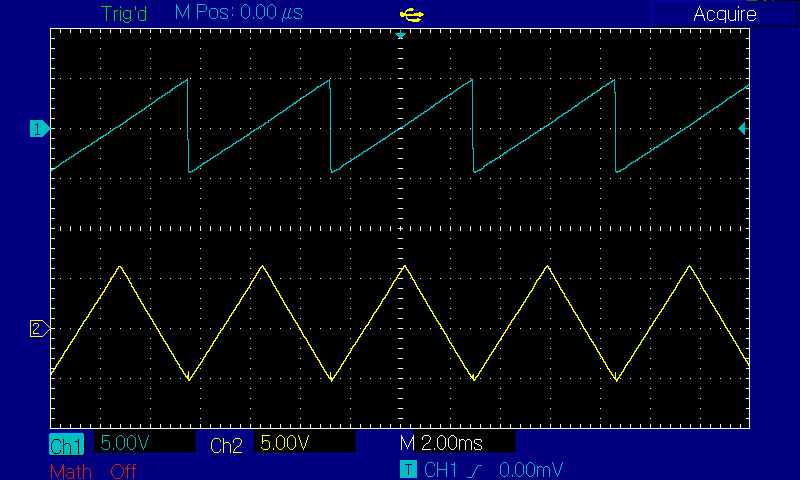
Trace 2. Blue trace is the original Sawtooth wave, yellow trace is the triangle wave.
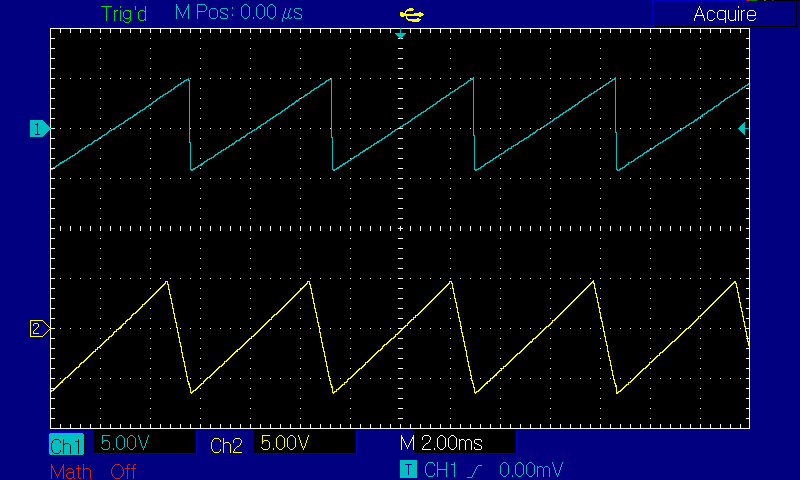
Trace 3. Blue trace is the original Sawtooth wave, yellow trace is the shaped wave.
This waveform twisting produces a sound similar to Pulse Width Modulation (PWM) for sawtooths. The shape twisting will also work with symmetrical waveforms such as triangle and sine waves, again producing PWM like tones.
The SHAPE control can produce a wave twisting effect from most waveforms (with the exception of square waves), whether they are symmetrical or asymmetrical. Under many conditions the transfer function is not perfect, so different harmonics may be generated too. The OFFSET control allows a bias to be added to the incoming waveform, either to bias it correctly around zero or to deliberately offset it for more distortion and harmonics.
A CV applied to the SP CV input socket will allow external control of the SHAPE function.
DISTORT
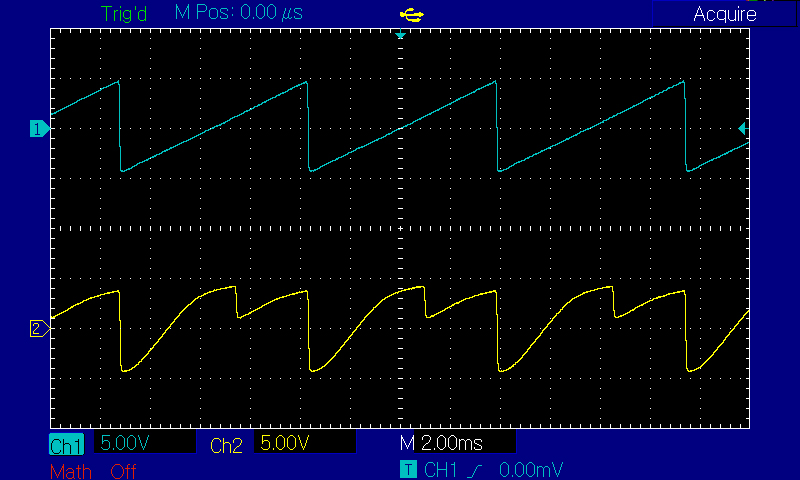
An audio signal applied to the DIST IN socket can be distorted using the unipolar DISTORT control knob. This distortion will generate additional harmonics at the DIST OUT socket. Applying an offset to the distorted signal by adjustment of the bipolar DCV OFF control knob will produce a variable 'mangling' of the waveform which will generate even more additional harmonics. The DCV OFF control adds or subtracts a bias voltage to the CV signal, to give an extended range of control. There is also a single stage, switchable wavefolder, which can be used with either Soft or Hard clipped waveforms, selected by the S-CLIP/H-CLIP switch. Trace 4 shows the effect of applying maximum distortion, no offset and Soft Clipping.
A CV applied to the DIST CV input socket will allow external control of the DISTORT function.
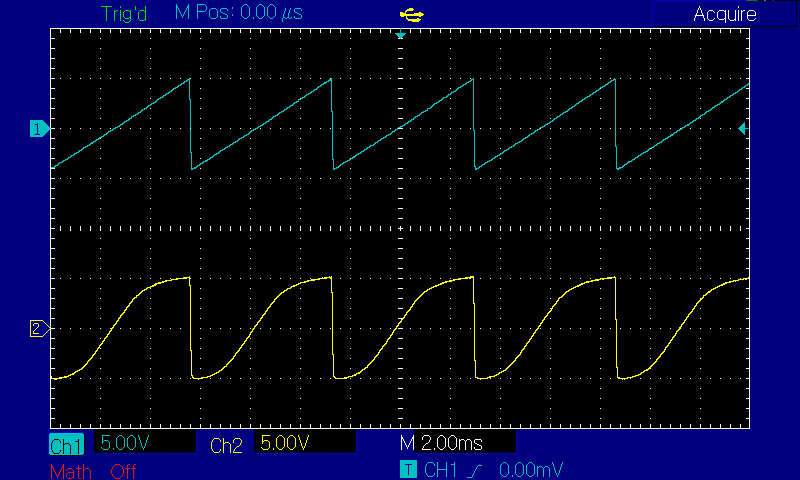
Trace 4. Blue trace is the original Sawtooth wave, yellow trace is the Soft Clip wave.
S-CLIP and H-CLIP
This switch only works with the distortion path. In the S-CLIP position (up), Soft clipping is enabled for the distortion signal. In the H-CLIP position (down), Hard clipping is enabled for the distortion signal. Trace 5 shows the same settings as Trace 4 but with Hard Clipping enabled.
Trace 5. Blue trace is the original Sawtooth wave, yellow trace is the Hard Clip wave.
NORM/FOLDED
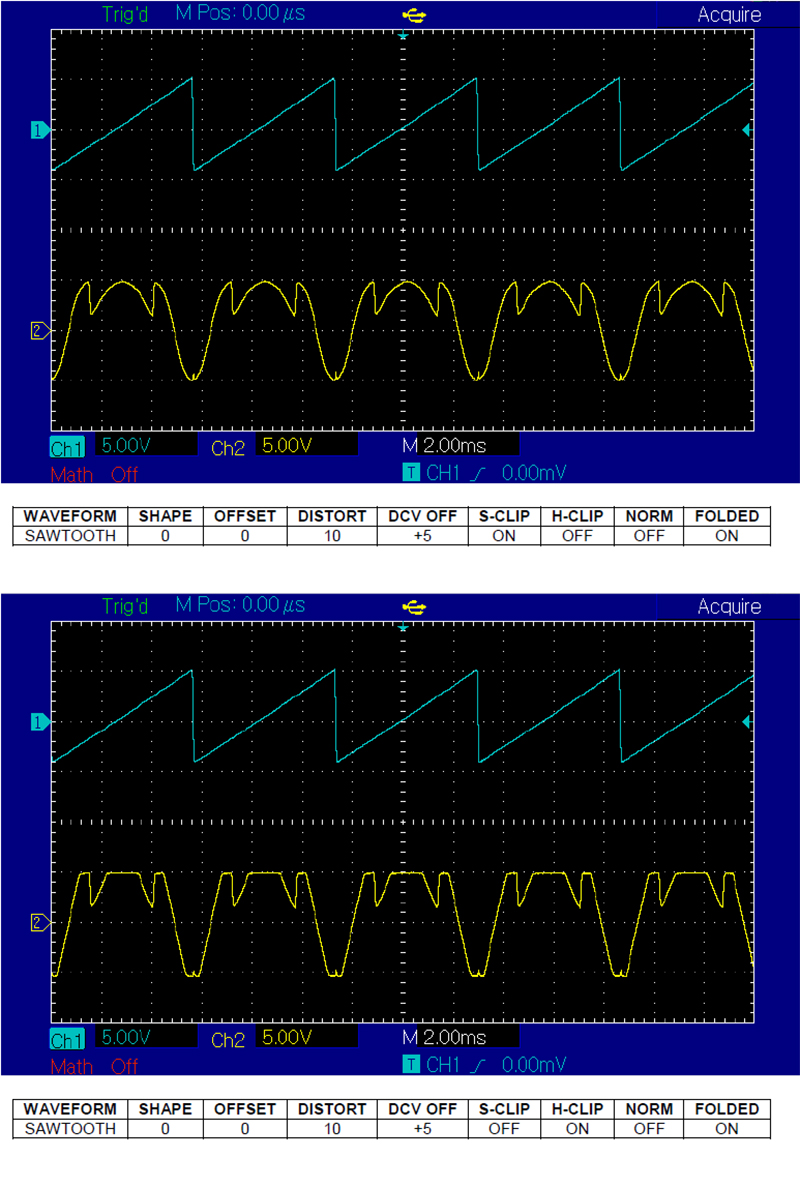
This switch only works with the distortion path. In the NORM position (up), wavefolding is disabled for the distortion signal. In the FOLDED position (down), wavefolding is enabled for the distortion signal. Trace 6 shows the effect of applying maximum distortion, maximum offset, with folding and Soft Clipping enabled. Trace 7 shows the same settings but with Hard Clipping enabled.
Trace 6. Blue trace is the original Sawtooth wave, yellow trace is the Soft Clip Folded wave.

Trace 7. Blue trace is the original Sawtooth wave, yellow trace is the Hard Clip Folded wave.
FURTHER WAVEFORM EXAMPLES
There is much flexibility in the choice of waveforms that can be generated by the module, depending on the numerous settings that can be dialled in using the four control knobs, two switches and, of course, the two CV inputs. Here are some examples of what can be achieved by using sawtooth and triangle waves as the input waveform. In all cases, the blue trace is the original waveform and the yellow trace is the output waveform. The table under each trace indicates the settings used:-


Online video user guide
Here's the much requested in depth tutorial and online user guide for the V-Shape, everything you need to know about getting the very best from this great sounding all analogue wave twisting and distortion module.
In depth review of the V-Shape from Sonic Voltage
Some interesting V-Shape patches from Alex4
Many thanks to Steve Richards for writing the V-Shape module user guide, and also for writing the "In Depth" section and providing multiple oscilloscope screen captures to illustrate the many different waveforms that can be generated from regular sawtooth or triagle waveforms.